Instruments
Over half a million dollars of detection equipment.
Counter-surveillance is an equipment-limited discipline. There is no amount of experience that lets a technician hear a 417 MHz carrier or see a semiconductor junction inside a wall. Below is what we carry, and — more usefully — what each instrument is actually for. We re-train on it twice a year.
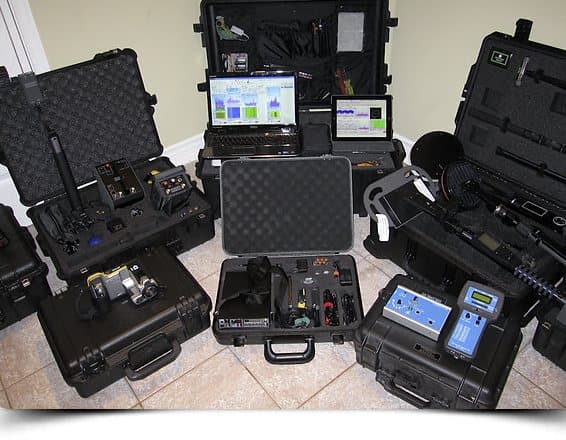
What we bring, and what each piece is for
Sixteen classes of instrument. Each finds something the others are blind to.
The core instrument. Displays every radio signal present across a very wide frequency range, so an unexplained carrier stands out against the building's normal radio background.
Proves that a suspect signal is carrying sound from the room you are standing in, by matching a known noise we introduce against what the signal is transmitting. This is what turns a suspicion into a finding.
Fast, wide-net sweeping used to walk a located signal down to the object producing it, once the analyser has told us roughly where to look.
Finds electronics that are switched off, out of battery or storing to a card — devices that emit nothing at all. It responds to the semiconductor junctions themselves, through wood, plaster and fabric.
Tests the handset itself for hook-switch bypass — the modification that turns a telephone sitting innocently on its cradle into a live microphone for the room.
Examines the pair for series and parallel taps, and for voltage and current behaviour that does not match a clean, untampered line.
Sends a pulse down a cable and times the echoes, revealing exactly how many feet along a run an unexpected junction, splice or tap sits — even buried inside a wall.
Detects the electrical imbalance that an attached device introduces into an otherwise balanced telephone pair.
Finds devices that use the building's own mains wiring as their transmission path, sending audio out through the power circuit rather than over the air.
Examines the electrical system for the signalling and load signatures of concealed devices drawing power from it.
Traces where a given cable physically goes. Surprisingly often the answer is somewhere nobody in the building can account for.
Detects surveillance devices using infrared light to transmit, and narrow-beam laser links — neither of which appears anywhere on the radio spectrum.
Puts a camera inside wall voids, ducts, ceiling spaces, furniture and cavities, so a wall does not have to be opened to be examined.
Optical detection that finds the lens itself by its reflection, which works on cameras that store to a card and never transmit a thing.
Checks wiring and structure for the presence of buried microphones and for audio being carried along paths that were never intended to carry it.
Reveals the small heat signature of powered electronics concealed inside objects, fittings and building fabric.
The honest comparison
Why the detector you can buy online will not do this.
We are asked this constantly, and it deserves a straight answer rather than a sales pitch. Those devices do one thing: they light up near a strong, continuous radio signal.
That is genuinely useful against exactly one category of threat — a cheap, always-on transmitter. It is also why the same device lights up enthusiastically beside your own Wi-Fi router, your baby monitor and your neighbour’s smart meter.
The real risk is not the hundred dollars. It is walking away believing a room is clear when nothing capable of finding the likely threat was ever switched on.
What a hand-held detector cannot find
- A recorder that stores to a memory card and never transmits
- A burst device that transmits for milliseconds an hour
- A voice-activated device that is silent while you sweep
- A device that is simply switched off or out of battery
- A carrier-current device using the building’s mains wiring
- A series or parallel tap on a telephone pair
- A hook-switch bypass inside a desk telephone
- A camera storing locally with no radio output at all
- An infrared or narrow-beam laser link
Every one of those is routine. Several of them are the norm in anything above the hobbyist level.
And the part that is not equipment.
Instruments do not find devices — trained people using instruments find devices. Our technicians re-train twice a year, and we send the same people back to sites they have swept before, because someone who knows what a room looked like last year notices what has changed in it.
Ask us to demonstrate any of it.
We are happy to walk you through what we will bring, what each instrument does and what it will and will not find in your specific situation — before you commit to anything.